What brand strategists actually charge (and what gets them from $4,500 to $10,000+)
"What should I charge?"
It's the question I get asked a lot. By designers adding strategy to their offer. By strategists five years in. By people who've just finished their first project and have no idea whether they undercharged.
For a long time I didn't have a good answer. When I left Landor to go independent, I asked around, got a handful of numbers from people I trusted, and took a punt. Most people do the same. Brand strategy pricing happens behind closed doors, in one-off conversations, usually with someone who doesn't have your experience. So people guess. And most of them guess low.
So this year I went and found out.
172 brand strategists, designers and copywriters told me what they charge for brand strategy, what they'd ideally like to charge, how long their projects run, what they put in them, and how confident they feel doing the work. The full results are in The State of Brand Strategy Pricing 2026, which you can download for free here. Here are the headlines.
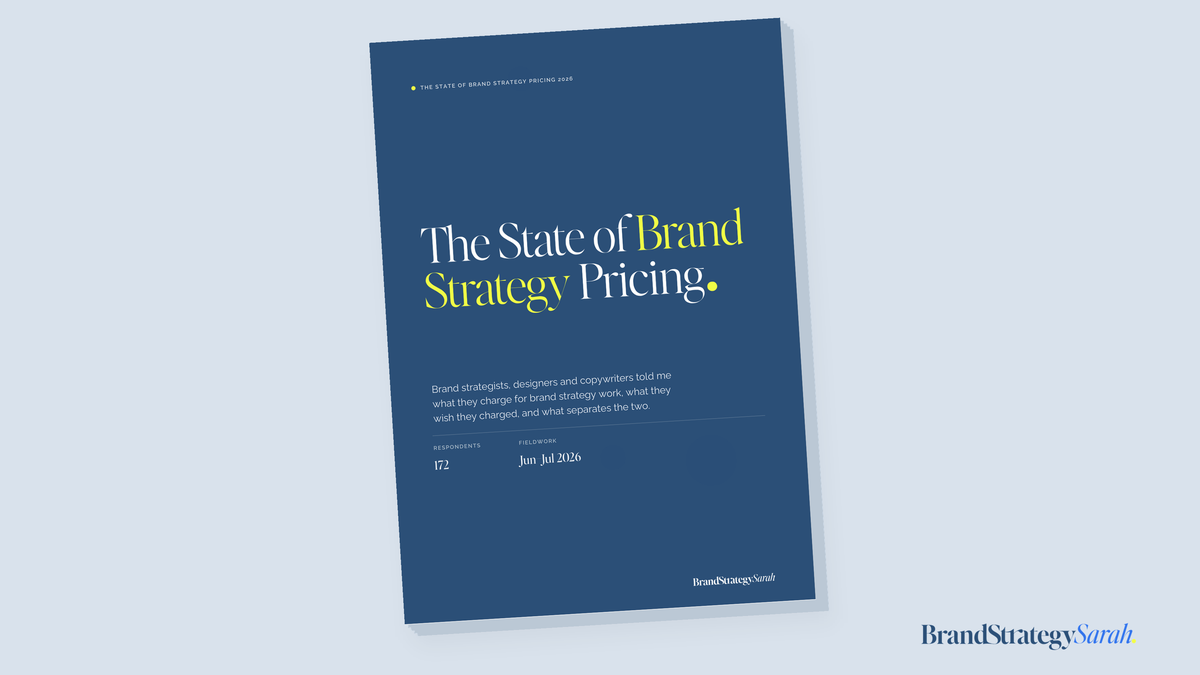
The State of Brand Strategy Pricing 2026: the headline numbers
- The median brand strategy project fee is $4,500. Half of those who charge for it charge less than that.
- 43% want to charge $10,000 or more, the most common ideal fee by far. Only 30% charge it today.
- Client size matters more than anything else. Only 7% of people working mainly with micro businesses charge $10,000+, against 42% of people working with SMEs or bigger businesses, for a near-identical scope of work.
- Research is what gets paid for. 83% of people charging $10,000+ interview their client's customers, compared with 47% of people charging under $3,000.
- Confidence has a price tag. People who are very confident delivering brand strategy charge $10,958 on average. People who are not very confident charge $4,566, and discount four times as often.
- Training tracks with confidence. 87% of people who've done more than one brand strategy course call themselves fairly or very confident.
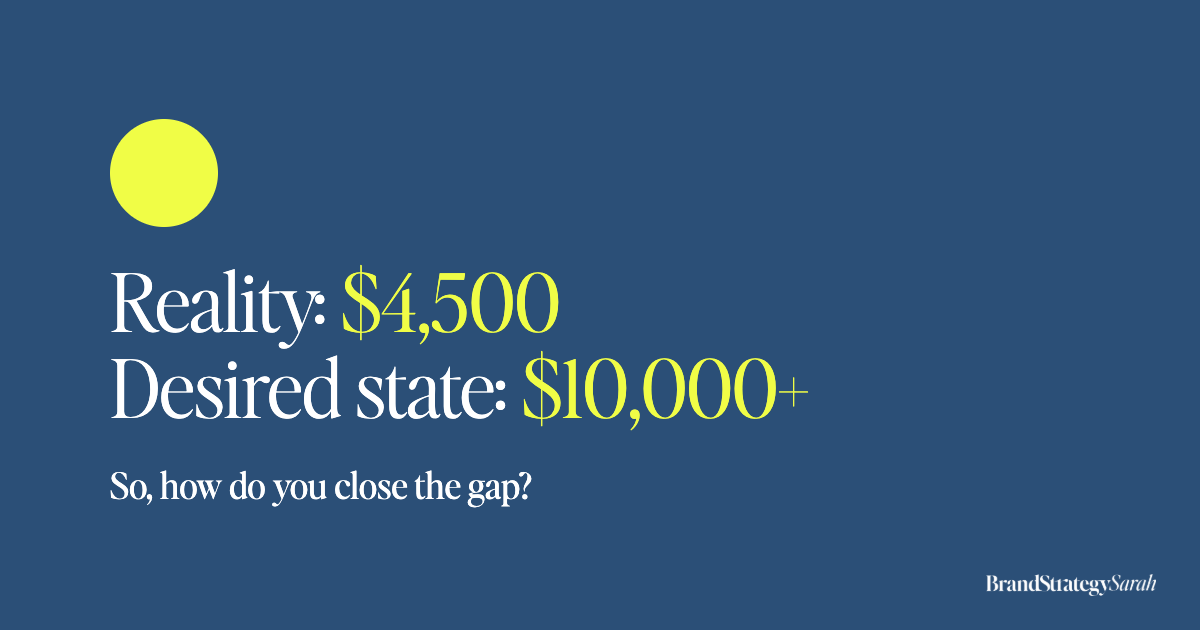
The typical project is $4,500. The number people want is $10,000.
The median brand strategy project in this survey is $4,500. Half of those who charge for brand strategy charge less than that.
Ask those same people what they'd ideally (and realistically) like to charge and the most common answer, by a distance, is $10,000 or more. 43% picked it. Only 30% charge it today.
And 59% want to charge more than they currently do. Only 4% want to charge less.
What struck me is how modest that ambition is. Nobody's dreaming of a $100,000 project (they do exist, by the way). They just want to get to five figures.
If you're sitting at $4,000 wondering whether you're the only one, you're not. You're the middle of this market.
Low pricing is a phase, not a life sentence
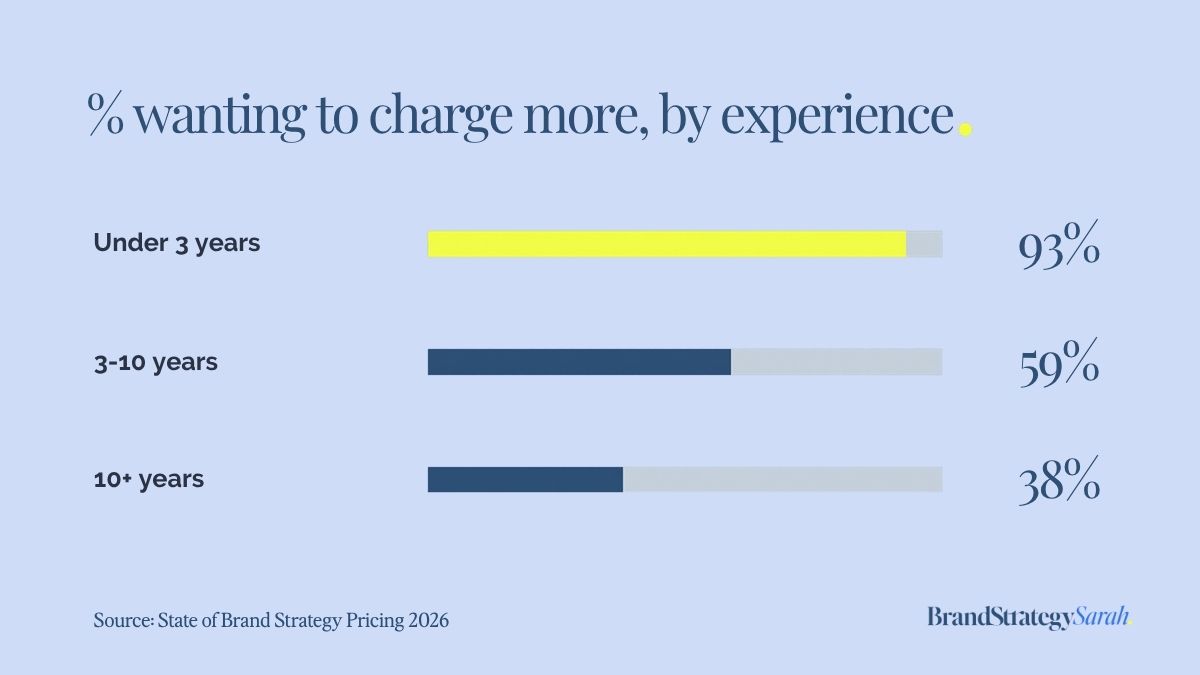
93% of people with under three years' experience want to charge more. At three to ten years it's 59%. Past ten years it drops to 38%.
The average charge roughly doubles at each step: $3,456 under three years, $6,750 at three to ten, $13,118 at ten plus. (These are estimated from price bands, so treat them as directional, not exact.)
So if you're two years in and charging $2,000, don't beat yourself up. You're exactly where the data says you'd be. The real question is whether you have to wait ten years to move that number. The rest of the data says you don't.
Four things separate the $10,000+ group from everyone else
This is where it gets useful. I compared the people already charging $10,000+ with the people wishing they were. Four things kept coming up. Here's a taste of each. The detail, the charts and what I'd actually do about it are in the full report.
1. They don't bury strategy inside a design quote
75% of people who sell brand strategy as an add-on to design, copy or marketing want to charge more. That's the highest of any group in the survey.
If strategy is a line item in a design proposal, the client reads it as a phase of the design job. It's the first thing they trim when the budget tightens. And you have no separate number to defend, because you never gave them one.
2. They're picky about who they sell to
People working mainly with micro businesses and solopreneurs hit $10,000+ just 7% of the time. Everyone else hits it 42% of the time.
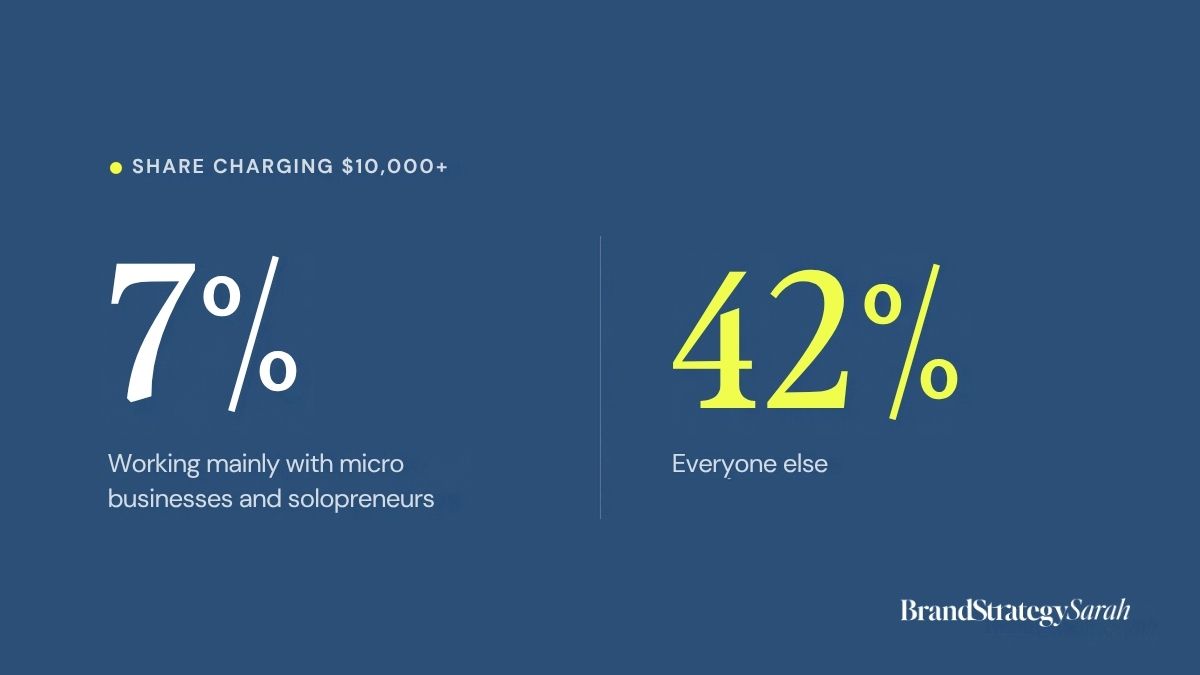
Here's the uncomfortable bit. It isn't because micro-business projects involve less work. People are running roughly the same number of stages whether they charge high or low. The same process just gets priced smaller when the client is small. (There's a sharper version of this in the report, including the client size where the jump really happens.)
3. They go and find things out
83% of people charging $10,000+ interview their client's customers. Of people charging under $3,000, it's 47%.
The same pattern shows up for employee interviews and workshops. Everything that gets you out of the leadership echo chamber is far more common at the top of the market. And the things people often add to a proposal hoping to make it worth more, like implementation guidance and marketing planning? No premium at all. They're actually slightly more common at the bottom.
4. They're confident. And a lack of confidence is costing everyone else
Very confident practitioners charge $10,958 on average. Not very confident ones charge $4,566.
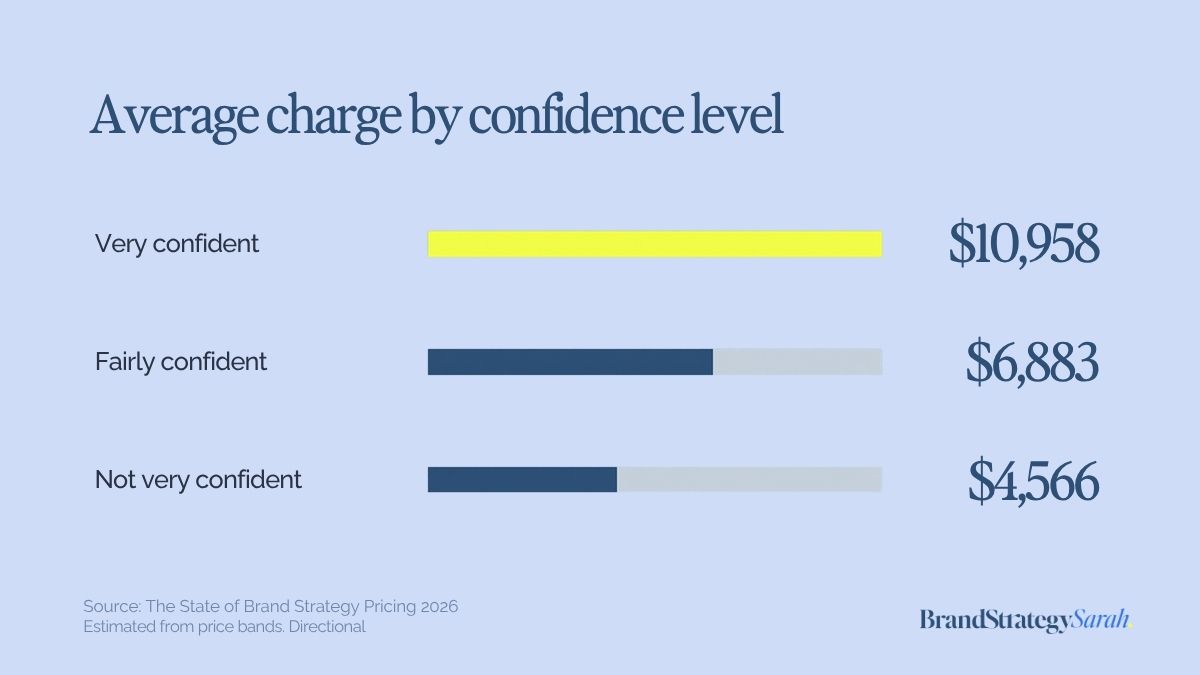
In the $10,000+ group, not one person said they were "not very confident". Not one. Half of them said "very confident", against 12% of the under-$3,000 group.
People who aren't confident also discount their work four times as often as people who are. Discounting isn't a price-point problem in this data. It's a conviction problem.
The part that surprised me most: only one in five people with three to ten years' experience call themselves very confident. That's a long stretch of a career spent doing real projects for real clients and still feeling like you're winging it.
What the data says about training
Yes, I run a course. So of course I wanted to know whether training shows up in the numbers. Here's what it said, including the bit I didn't love.
Training tracks with confidence, whatever the course. 87% of people who've done more than one brand strategy course call themselves fairly or very confident.
Where Brand Strategy Academy stands out is price. Completers average $9,837 a project, against $6,436 for people who trained somewhere else.
Now the bit I didn't love when I first saw it. The group of 12 people charging the super high fees are people who've never done any training at all! But when you dig into that, that group skews senior - they've been practicing for more than 10 years. And ten years ago there wasn't really any brand strategy training around. Even when I worked as a brand strategist at Landor - the world's biggest brand consultancy in the world at the time - I didn't go through a formal training programme. I learnt on the job.
So training isn't the only route to higher fees. Time gets you there too. Training just appears to be the quicker one. The full breakdown is in the report.
One interesting thing the data doesn't back up
Value-based pricing isn't the magic ticket. It often gets pushed as the only route to big fees. In this survey it's used by 27% of people. But in the group charging five figures, many different pricing models are used. In my experience - charging way beyond that $10,000 for over 20 years - clients always want transparency, and one magic number is not always the easiest way to show that.
What's in the full report
This blog is the headlines. The full report gives you:
- Every chart with its base size, so you can see exactly where you sit
- The client size where the $10,000 jump actually happens
- The full research-versus-delivery breakdown across all eight process stages
- What the data says about training and price
- Four practical things to do if you're at four figures aiming to reach those $10,000+ projects
Download The State of Brand Strategy Pricing 2026
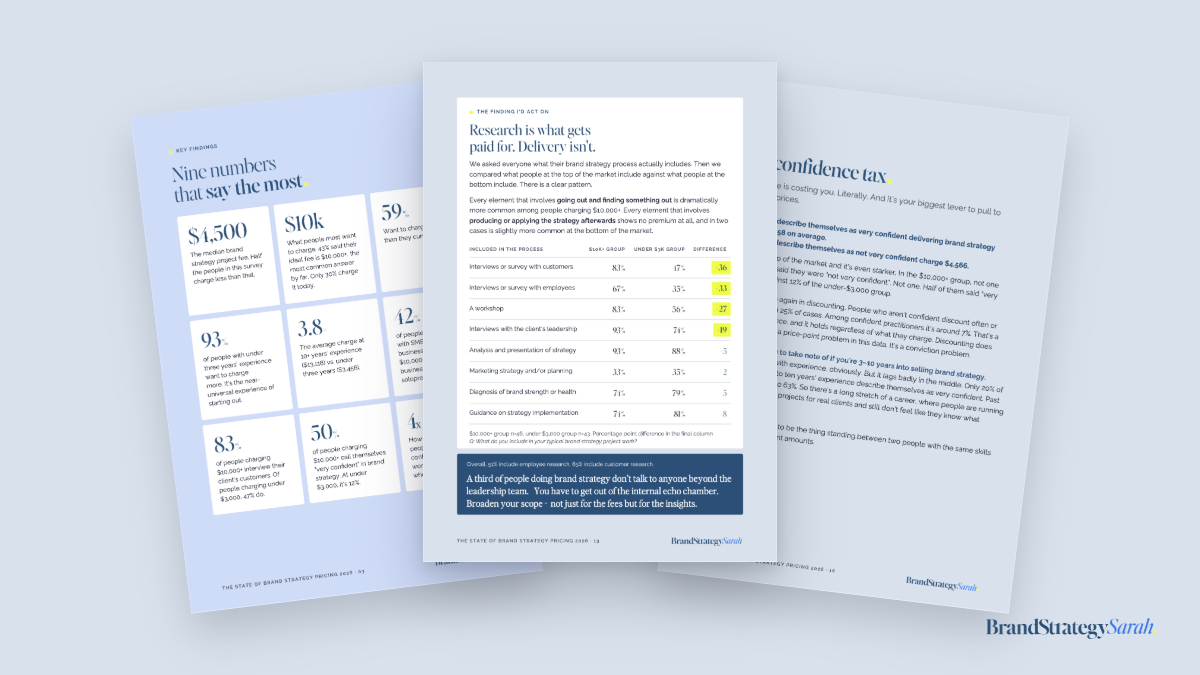
Thank you to the 172 people who took the time to tell me what they charge. That's how this topic gets less mysterious for everyone. I'll be running the survey again next year, so if you want to take part, please download the report and you'll hear when it goes live next year.
Hope this helps.
Liked this? Then you'll love this:
Brand Strategy in 7 Simple Steps
A free mini course that gives you a clear brand strategy framework based on 20+ years of experience.
Four short lessons, no cost, jargon-free.
By clicking submit, you agree to receive marketing emails from Brand Strategy Sarah about our products and services. Unsubscribe at any time.
Author