5 Metaphors That Sell Brand Strategy for You
Ever had that moment in a pitch where you can see the client glazing over?
You're explaining the value of brand strategy. You know it matters. You've seen the difference it makes. But the words coming out of your mouth sound like… a textbook. Or worse, like every other strategist they've spoken to. Fluffy, ungrounded in business outcomes and not something they could justify in a boardroom.
The client nods politely. Then asks if you can just do the logo.
That's where metaphors come in. Not as a creative flourish. As a selling tool.
Psychologists Thibodeau and Boroditsky at Stanford showed that metaphors don't just explain ideas. They shape how people reason about them afterwards. The frame you set in a pitch meeting stays in your client's head long after you've left the room. And here's the really useful part: a good metaphor is something your client can repeat. They don't just buy brand strategy from you. They have to sell it internally, to their CEO, their board, their team. "We need a moat" is something a CEO can say in a meeting. "We need to increase our meaningfully different brand perception score" is not.
So here are five metaphors I use, each matched to a specific client problem. Use whichever one fits the conversation you're actually having.
How to Sell Brand Strategy to Clients: 5 Metaphors with Evidence
If your client's business feels chaotic and reactive...
Use: The Compass
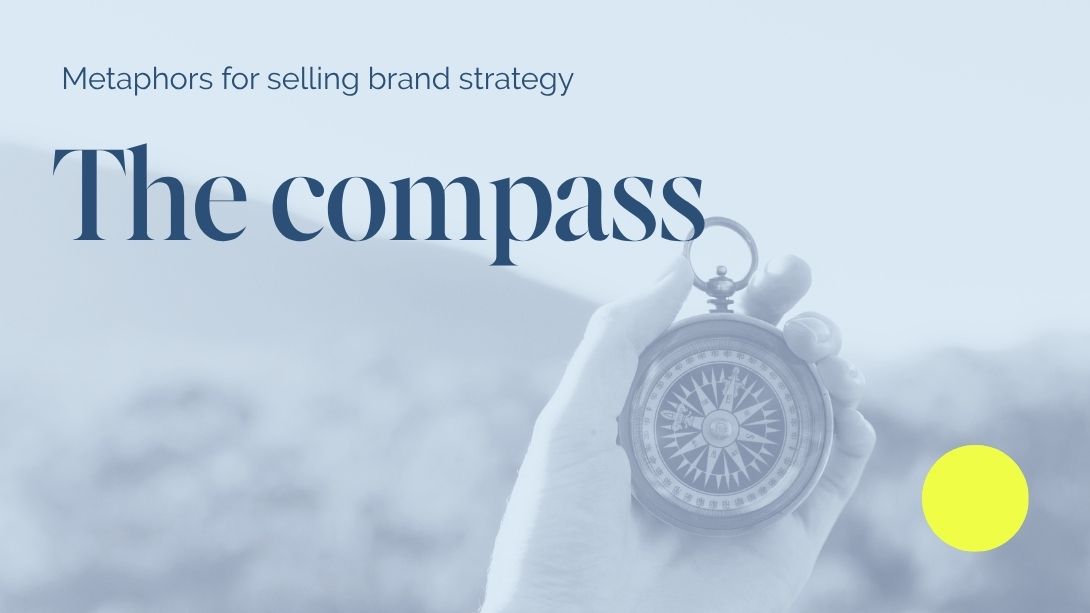
A compass doesn't move you forward. It tells you which direction forward actually is.
Tell your client this: Without brand strategy clarity, you're making every decision from scratch. Should we sponsor this event? What should we say in our proposals about why to work with us? How should we describe ourselves to prospects? Should we start offering this new service? Every question triggers a debate because there's no shared reference point. With a brand strategy as your compass, every decision can be checked against it: does this move us closer to what we say we do for people and why we do it? Yes or no? Does this decision reflect who we are - the values we share? The debates get shorter. The decisions get better. The business stops spinning and starts moving forward.
Then back it up:
An HBR/EY study found companies with a clear answer to why we exist outperformed the S&P 500 by a factor of 10. Deloitte shows purpose-driven companies grow 3x faster. IBM data shows 80% of employees feel more engaged when work aligns with core values. And Modern Survey found employees who say their values are "known and understood" are 51 times more likely to be fully engaged.
Kantar data shows brands that build strong and consistent associations in people's minds predispose more people to buy a brand more often. Brands with strong predisposition have nine times more volume share, people will pay twice the price for them and they're twice as likely to grow value share in the future than brands with weak predisposition. Get clear on what associations you want to build, then start building them.
Reach for this one when: your client keeps changing their messaging, marketing feels reactive, and different teams describe the company differently. The Compass speaks to the exhaustion of making every decision from scratch and the clarity that comes from having a direction to follow.
If your client is wasting money on marketing that doesn't compound...
Use: The Filter
Most businesses think they need more ideas, more content, more campaigns. Their actual problem is they have no way to sort the good from the bad.
Tell your client this: Brand strategy is a filter. It lets you say "no" faster and "yes" with confidence and consistency. Without it, every decision burns time and budget. With it, the answer is already half-made. And the work that gets through actually compounds, because it's all building the same thing. Not just short term sales but long-term brand value.
The killer stat for this one:
The System1 x IPA study - The Magic of Compound Creativity - found the least consistent brands would need to spend 1.75x more on media in year to achieve the same growth as consistent brands. For those inconsistent brands that works out as £14.1 MILLION more a year each.
Brands in the top 20% for consistency reported greater large brand and business effects - higher scores on metrics that included awareness, differentiation, salience, sales value gain, profit gain and market share gain.
System1 x IPA x YouGov data shows the cost of constant change: brands that changed agencies twice or more over five years scored just 2.3 on creative quality versus 3.0 for stable brands. Worse, their distinctiveness actually went backwards (-0.7). Changing direction constantly doesn't just slow you down. It sends you backwards.
Reach for this one when: your client has been spending on marketing but nothing compounds. They keep changing campaigns or agencies. The brand looks different depending on who made the last decision. The Filter speaks to wasted budget and the frustration of starting from scratch every quarter.
If your client is growing but falling apart as they do so...
Use: The Magnet
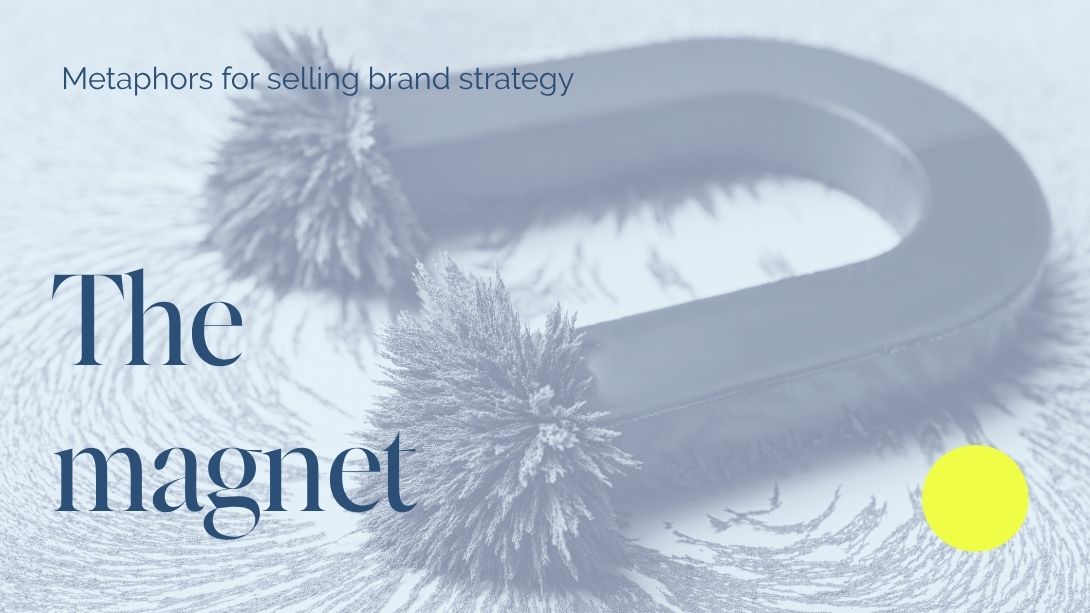
Here's what actually makes a magnet work. Every piece of iron has tiny magnetic domains. In ordinary iron, those domains point in random directions. They cancel each other out. No pull. In a magnet, every domain is lined up, pointing the same way. That alignment is what creates the force. The pull isn't manufactured from outside. It's generated from within. I love this metaphor and I learnt it from a client of mine - Mr Pisani - the enigmatic chairman of Corinthia Hotel group. He used it to talk about the power of everyone within the business working in the same way, with the same purpose, and I worked with him and the group to define the brand strategy that identified that.
Tell your client this: Right now, your website says one thing, your sales team says another, people are inducting into the business differently depending upon the person delivering it, your social content has a different personality every week. Every element has energy, but it's all cancelling each other out. It's all noise and no pull. Brand strategy aligns all those domains: messaging, identity, tone, customer experience, employee experience, culture, product decisions. When they all point the same way, you don't have to push harder to attract people. The pull starts to happen.
Back it up:
Kantar's research shows brands with strong clarity contribute 70% more to sales. An HBR/Rokt study found strong brands outperform weaker ones by 3:1 in customer acquisition costs. The System1 x IPA study found the most aligned brands achieved a market growth rate of 1.8 versus just 0.8 for the least consistent. Same spend. More than double the growth.
Brands with fluent devices running for 4+ years scored 3.5 on creative quality versus 2.6 for brands with none. The domains take time to align. But once they do, the pull compounds. Data from the same study shows the most consistent brands hit 62% brand popularity versus 52% for the least consistent.
Reach for this one when: your client has all the ingredients but no alignment. Good people, decent products, reasonable budgets, growth ambitions, but everyone doing and saying their own thing.
If your client has good people pulling in different directions...
Use: The Orchestra
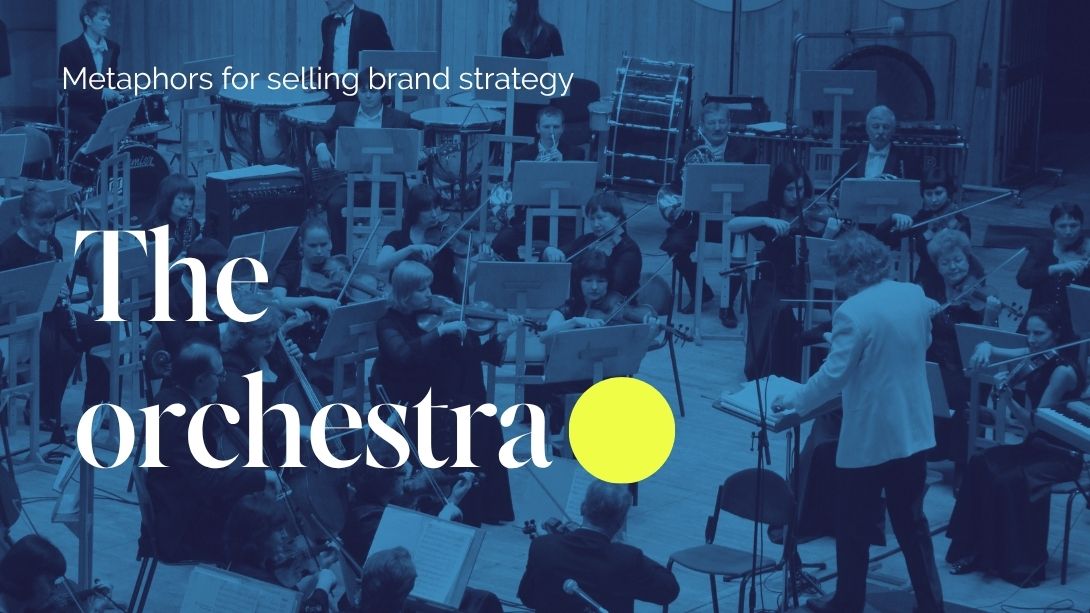
Imagine 40 talented musicians on a stage. No conductor. No score. The violinist plays jazz. The drummer plays a march. The cellist does something experimental that has nothing to do with anyone else.
Every individual performance might be brilliant. But the audience just hears noise.
Tell your client this: That's your business right now. Marketing writes in one tone. Sales pitches a different value proposition. The website tells one story. Instagram tells another. The CEO describes the company one way at a conference and the new hire describes it differently at a networking event. Everyone is working hard. Nobody is working together. And the customer can't make sense of what they're hearing. So they tune out.
Brand strategy is the score and the conductor combined. It doesn't replace the musicians. It gives them the same piece of music to play.
Back it up:
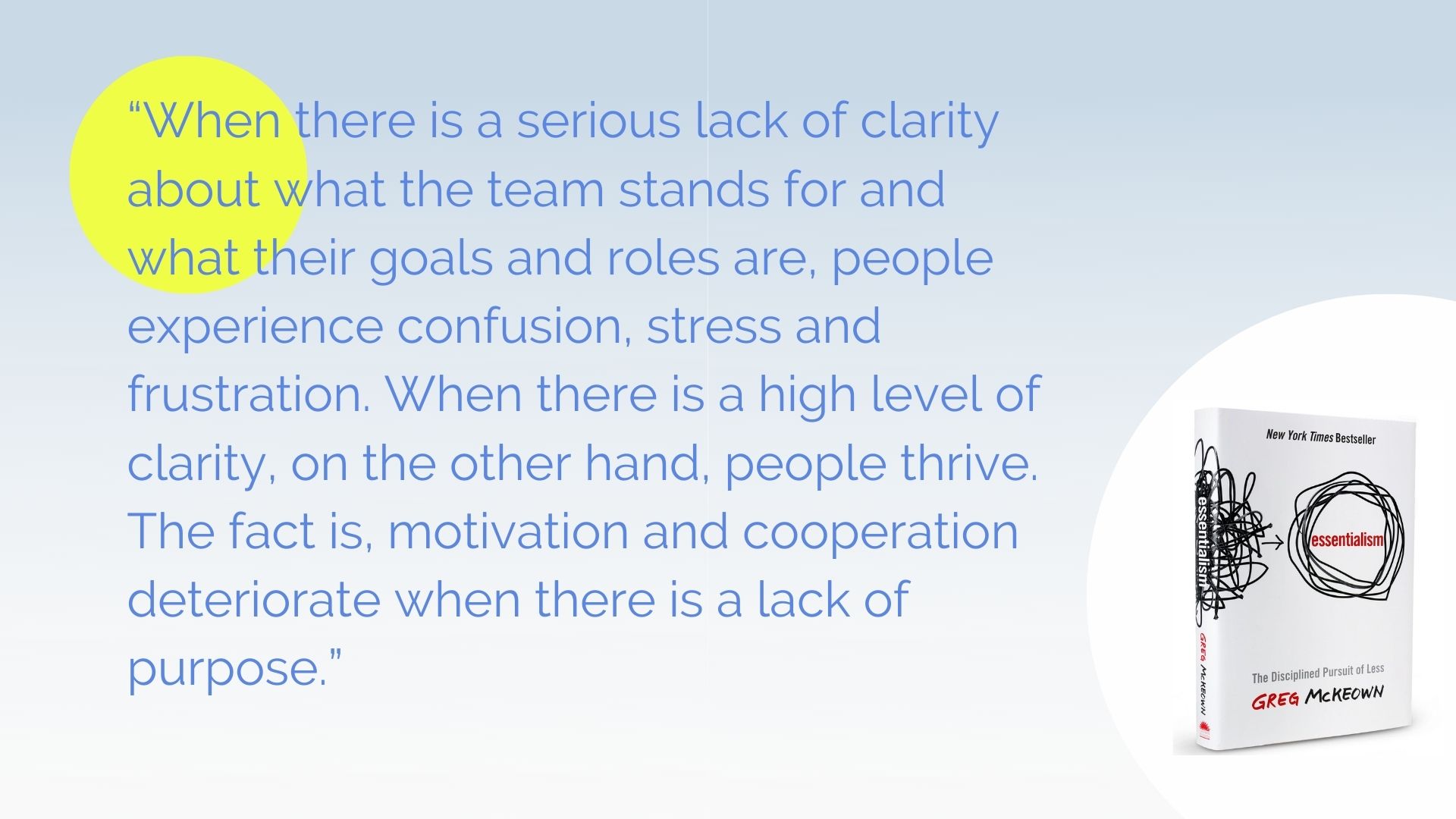
Greg McKeown's study of 500+ people across 1,000 teams (in Essentialism) found a consistent pattern: clear shared direction transforms performance. Without it, energy and motivation diminish.
 HBR/EY found 84% of executives agreed transformation efforts succeed more when integrated with purpose. Purpose-driven companies reported 30% higher innovation and 52% vs 16% success rates on major transformation efforts.
The System1 x IPA data is the sharpest here: consistent brands report 55% achieving very large profit gains versus just 18% for inconsistent ones. Same market. Same spend. The difference is whether everyone was playing the same piece.
Reach for this one when: your client has a team problem disguised as a brand problem. Siloed departments, no shared language, no shared story. The Orchestra speaks to leaders who can feel something is off but can't name it.
If your client is worried about competition and pricing...
Use: The Moat
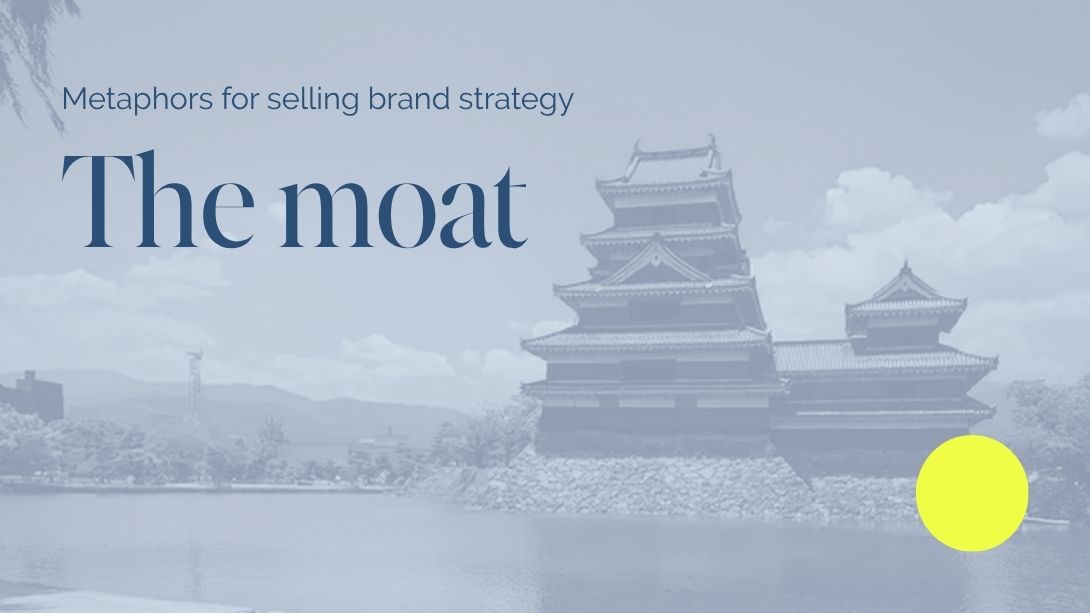
Warren Buffett describes strong brands as moats, explaining that the most important thing he looks for in a business is "a wide and long-lasting moat around it, protecting a terrific economic castle." He identifies two types of moats: being the low-cost producer, or owning a powerful brand that consumers willingly pay more for.
Tell your client this: Brand strategy is how you dig your moat. Without it, you're an undefended castle. Competitors can walk right up, undercut your price, copy your offer, and take your customers. With a strategy, you've created a barrier made of meaning, emotional connection, and distinctiveness that competitors can't replicate, no matter how much they spend. And moats widen over time. The longer you commit, the harder you are to attack.
Then back it up with one of these:
A McKinsey study showed that top brands outperformed the market by 73%. Kantar's research shows consumers pay on average 37% more for brands they regard as Meaningfully Different. Even price-driven consumers pay 14% more. And MASB analysis shows brands can contribute over 50% of total enterprise value.
The System1 x IPA Compound Creativity study shows moats widen over time: the most consistent brands grew their creative effectiveness from 3.3 to 4.1 Star Rating over five years. The least consistent flatlined at 2.6.
Reach for this one when: your client is being undercut on price, watching new entrants, or struggling to justify premium pricing. The Moat speaks to the boardroom fear of being out-competed. They're just competing on price because nothing gives people another reason to choose them.
Brand strategy work identifies this meaningful difference that helps you start digging this moat.
This is one of the first things I teach inside Brand Strategy Academy because it reframes how students think about pricing their own strategy work too. If a brand moat is worth up to half a company's enterprise value, the person who helps build it shouldn't be charging logo rates.
Quick cheat sheet: match the metaphor to the problem
Worried about competition and pricing? Lead with the Moat.
Drowning in disconnected decisions? Lead with the Compass.
Wasting budget on marketing that doesn't build? Lead with the Filter.
Growing but falling apart as you do so? Lead with the Magnet.
Talented teams pulling in different directions? Lead with the Orchestra.
Open with the metaphor. Let it land. Then bring in one or two stats. That's the formula: metaphor first, evidence second. The metaphor opens the door. The data walks you through it.
You now know a few ways to sell brand strategy. Do you know how to do it?
These metaphors will help you get the client to say yes. But then what?
The client says "okay, let's do this." You need a process. The right questions to ask in research. A framework for the workshop. A structure for the deliverable. A way to price it. A timeline that works.
That's what Brand Strategy Academy is for.
It's the step-by-step process I've used across 70+ brand strategy projects over 20+ years, packaged so you can use it on your very next client. Not theory. Not more frameworks to think about. The actual tools you can use on a client today.
It covers the process from pitch to deliverable. Pricing and proposal templates. Research and workshop scripted guides. 40+ examples from the world's most valuable brands showing you how it's done. Step-by-step case studies. Live Q&A sessions where you can bring your real client problems. And bonus masterclasses that go deeper on how to expand your strategic skills.
450+ designers, strategists, copywriters, and marketers have been through it. The most common thing I hear afterwards is "I wish I'd done this years ago." Because it finally makes brand strategy feel simple enough to sell confidently and deliver brilliantly.
If you've been thinking about it, don't waste another month. The next set of live Q&A coaching sessions with me start on April 29th. Join Brand Strategy Academy here.
Liked this? Then you'll love this:
Brand Strategy in 7 Simple Steps
A free mini course that gives you a clear brand strategy framework based on 20+ years of experience.
Four short lessons, no cost, jargon-free.
By clicking submit, you agree to receive marketing emails from Brand Strategy Sarah about our products and services. Unsubscribe at any time.
Author