Why It’s Time to Level Up Your Brand Strategy Offer: From Micro Clients to SMEs
If you’re a designer who is starting to offer brand strategy, or you’re already trying to sell strategy to very small businesses, this is the moment to rethink not just your offer, but your market.
For a long time, micro businesses and start-ups were a natural place to begin. They were accessible, they needed design, and they were often willing to work with freelancers. But the market is changing. Today, very small businesses have more low-cost ways to get early-stage brand and design support than ever before, including AI tools and DIY platforms that help them create logos, visual systems, messaging, and simple brand assets on their own.
That does not mean freelancers are losing relevance. It means the opportunity is moving. The stronger, more valuable move is to shift upward into the small and medium-sized business market, where companies have real complexity, real budgets, and a genuine need for strategic brand thinking.
Micro businesses are not the best home for high-value brand strategy
This is not about dismissing micro clients. It is about recognising what stage of business they are in.
Most micro businesses are still proving demand, managing cash flow tightly, and keeping their operations simple. They often need speed, affordability, and practicality more than a robust strategic process. Many are comfortable using accessible tools like Canva and AI-assisted creative platforms to get an identity, some messaging, and a decent-looking presence into the market quickly.
That is why moving upmarket is no longer just a nice option for designers who want to offer strategy. It is increasingly a smart and necessary evolution. The value of bespoke human thinking becomes more obvious when a business reaches the point where DIY tools are no longer enough because the challenge is no longer “make me a logo,” but “help us align the business, sharpen our positioning, and make better decisions as we grow.”
Why SMEs are the right next client
Small and medium-sized enterprises sit in the most attractive part of the market for independent brand strategists and brand identity designers. They are big enough to have meaningful problems, but not so big that they default to the largest agencies.
In the UK, the official Business Population Estimates for 2025 show there were 5,690,265 private-sector businesses at the start of the year, but only 8,335 of them were large businesses with 250 or more employees. Based on the same UK government dataset and [the size-band breakdown summarised here] there were about 258,520 small and medium-sized employer businesses with 10 to 249 employees. In the US, the SBA’s 2025 Small Business Profile for the United States shows that small businesses make up 99.9% of all firms, with 36.2 million small businesses and 62.3 million employees.
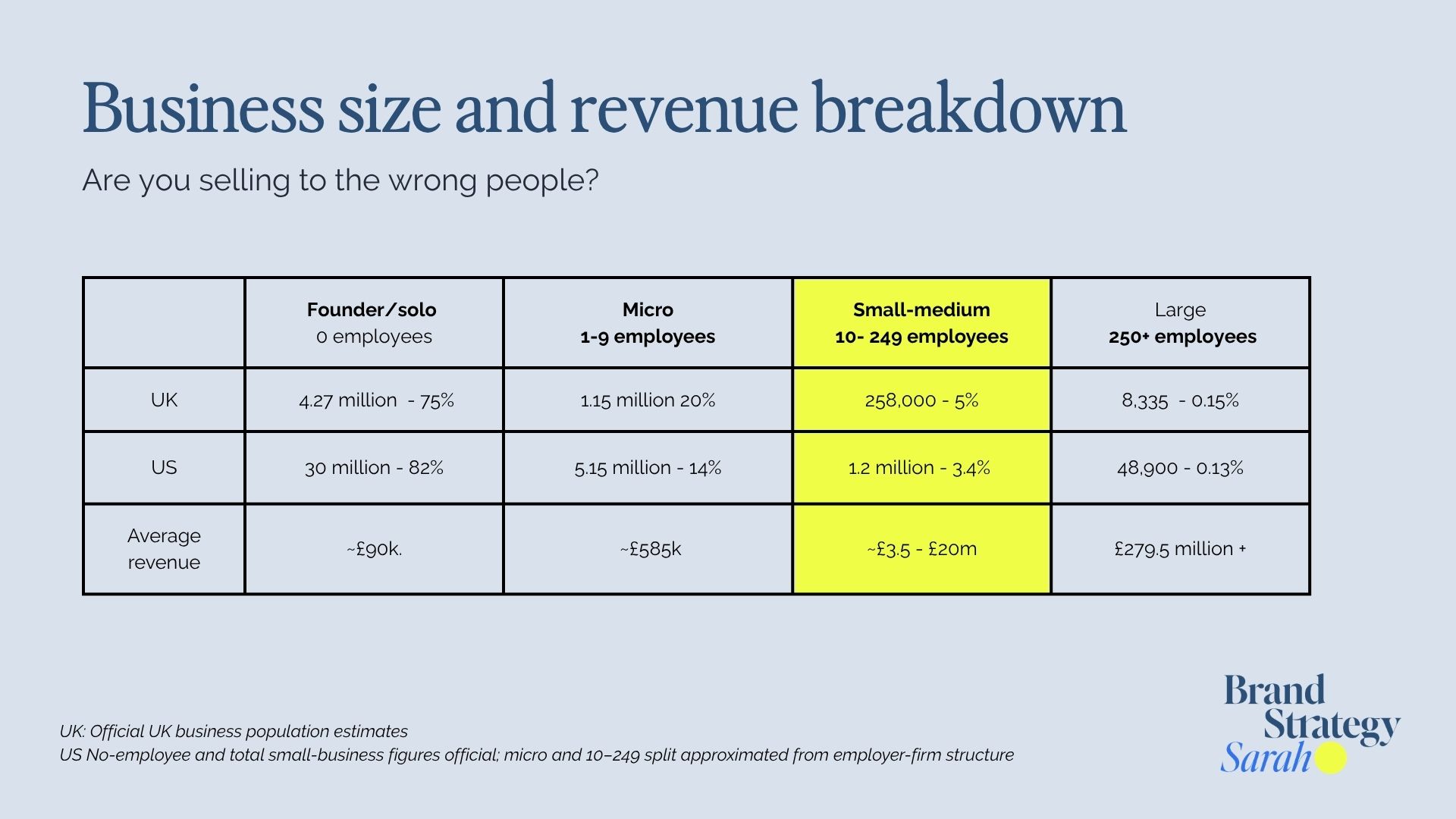
This is the sweet spot because SMEs are often dealing with growth, complexity, and professionalisation all at once. They are hiring, expanding, refining their offer, entering new markets, or trying to stop the business depending entirely on the founder. Those are all moments where brand strategy becomes commercially useful, not decorative.
Why SMEs actually need brand strategy
As businesses grow, the problems change.
Micro businesses usually need visibility and a basic presence. SMEs need alignment, differentiation, and direction. They need to know what they stand for, who they are for, why customers should choose them, how to attract and motivate employees, and how to create consistency as the business gets more complex.
This is exactly where brand strategy earns its place. A strong strategy helps an SME increase perceived value, focus on the right customers, improve consistency across touchpoints, and support better business decisions across marketing, sales, hiring, employee and customer experience. Recent reporting on UK SME economic concerns and how UK SMEs are navigating today's landscape show that growth, resilience, profitability, and professionalisation remain pressing priorities.
It can also reduce founder dependence by creating a shared direction that the wider team can use to make choices with more confidence.
For many SMEs, brand strategy is the difference between looking like a founder-led company that has grown out of control, and becoming a more professional, investable, scalable business.
Why this market is more lucrative for you
SMEs are not just more suitable for strategy work. They are more commercially viable clients.
According to the Latest UK Small Business Statistics Report, small employers in the UK already operate at meaningful revenue levels, and medium-sized firms are larger again, giving them far more capacity to invest in brand work than micro businesses. In the US, small business revenue benchmarks compiled here show the same broad pattern: as firms grow beyond the smallest stage, their revenue climbs quickly into levels where strategic brand support becomes commercially realistic.
That changes the conversation completely. Instead of trying to justify strategy as an extra step before design, you can position it as a business tool that helps them grow profitably, improve margin, attract talent, and make better strategic decisions.
To serve SMEs, your offer has to level up too
This is the important part: targeting better clients is not enough on its own. The offer must rise to match the client.
If your current version of brand strategy is essentially a discovery phase, an internal workshop, and a short write-up to support the identity process, that may be enough for a micro business. It is not enough for a serious SME.
An SME brand strategy engagement often needs more robust inputs and more confidence from you as the lead. That can include stakeholder interviews, better competitive analysis, clearer audience insight, stronger synthesis, sharper positioning frameworks, and a repeatable way to move from research into direction and decision-making.
The goal is not to become bloated or overcomplicated. The goal is to build a process that is robust enough to handle bigger questions, more stakeholders, and more commercial consequences.
A stronger offer usually includes:
- A repeatable discovery and research phase, not just one workshop
- A clear method for diagnosing the business problem behind the brief
- A structured approach to market, customer, and competitor insight
- A framework for positioning, messaging, brand principles, and strategic direction
- Practical outputs that guide identity, marketing, customer experience, and internal alignment
When you have that kind of process, you are not just selling “strategy before design.” You are offering a way for a business to clarify its future and move forward with more certainty.
Levelling up helps the client level up too
This shift is good for your practice, but it is also genuinely useful for the client.
When an SME invests in proper brand strategy, it is often part of a wider move to professionalise the business. The company is trying to become clearer, more aligned, more valuable, and less dependent on intuition or founder instinct alone.
A well-run strategy process gives them that. It helps translate business goals into something customers and employees can believe in. It gives leadership a clearer lens for decision-making. It gives design and marketing a stronger foundation. And it helps the organisation show up more coherently in the market.
That is why this work matters. You are not just making them look better. You are helping them operate better.
The positive opportunity in front of you
The rise of AI and DIY brand tools is not a reason for pessimism. It is a reason for clarity.
The simplest end of the market is becoming more self-serve. Early-stage founders can spin up logos, colour palettes, templates, and even basic websites with tools like Canva and AI-assisted design in an afternoon. That means bespoke design and strategy support will naturally feel like a stretch for many micro businesses in their earliest phase.
That does not make your skills less valuable. It just changes where they are most valuable.
The more these automated tools handle surface-level creative, the more obvious it becomes that human strategists and designers add their highest value where:
- There is real complexity to untangle
- There are multiple stakeholders to align
- There is serious revenue and risk on the line
- The work needs to connect business goals to human meaning, not just “look good”
That is exactly what small and medium-sized businesses need, and exactly where a strong brand strategy practice can thrive.
For designers who want to grow, this is the invitation: level up your client, level up your offer, and level up your role. Move from helping the smallest businesses get started to helping ambitious SMEs professionalise, differentiate, and grow with purpose.
That is not just a more lucrative place to work. It is a more valuable one too.
If you want help making that shift
If you’re reading this and thinking:
- “I know I don’t want to compete with Canva forever.”
- “I want to do deeper strategic work, but I’m not confident my process is strong enough.”
- “I’m not sure how to translate ‘big brand’ thinking into something an SME will actually buy and use.”
…that is exactly why Brand Strategy Academy exists.
Brand Strategy Academy is my course that takes everything learned from building and selling brand strategy at the highest levels at Landor, working on big, highly complex brands, and tailors it for the world you’re in now:
- Independent designers and strategists
- Wanting to work with small and medium-sized businesses
- Who want a robust, repeatable process they can trust
Inside the Academy, you’ll learn how to:
- Structure clear, confident brand strategy projects specifically for SMEs
- Go beyond “a workshop and a deck” into a process that genuinely supports business decisions
- Do just enough research to be credible and commercial, without blowing client budgets or drowning in analysis
- Lead clients through the journey from “we just need a new identity” to “we need a brand that supports our growth”
- Package and price your strategy work so it feels investable to them and sustainable for you
In other words, it is about taking the kind of strategic thinking used for global brands and reshaping it into something that fits SME realities: faster, focused, and commercially grounded.
If you’re ready to stop treating brand strategy as an add-on for micro clients and start treating it as a core, confident offer for serious SMEs, Brand Strategy Academy is your best next step.
Liked this? Then you'll love this:
Brand Strategy in 7 Simple Steps
A free mini course that gives you a clear brand strategy framework based on 20+ years of experience.
Four short lessons, no cost, jargon-free.
By clicking submit, you agree to receive marketing emails from Brand Strategy Sarah about our products and services. Unsubscribe at any time.
Author